The story of a famous sauce, from the forgotten recipes of the eighteenth century to the great books of French gastronomy.
A recipe I wanted to make as in the French books
Years ago, when I wanted to make an authentic béchamel sauce, I started looking online for a recipe from a French cookbook.
I didn't just want a quick version with butter, flour and milk. I was curious how the sauce was made in classic French cooking, following the rules and techniques described by the great chefs.
I found a book, followed the recipe and made the sauce.
Today, however, I no longer remember the title of that book.
The memory of the experience stayed with me, but I lost the exact source.
Perhaps that is exactly why, when I began organising my recipes into a digital cookbook, I wanted to keep not only the ingredients and method, but also their story and, when I know it, the book they come from.
Recently, curiosity brought me back to béchamel.
Who invented it? What did the recipe look like at first? And how much does the sauce we make today resemble the one in the old French books?
I set out to find the answer in gastronomy books published over several centuries and in historical research devoted to this sauce.
And I discovered a far more complicated story than I expected.
In the eighteenth century, béchamel could contain parsley, shallots, spring onion, pepper and nutmeg. Sometimes it was made with cream, sometimes with milk.
In 1903, Auguste Escoffier published a recipe that even contained veal.
And one of the most interesting early culinary records is a dish of turbot à la Bechameille, published in 1733.
But let's begin with the name.
A sauce named after a marquis
The name béchamel is associated with Louis de Béchameil, Marquis de Nointel (1630–1703), a French financier who held important offices during the reign of Louis XIV.
The marquis was connected to the refined world of the royal court, and his name remained attached to one of the best-known sauces of French gastronomy.
This is also where the legend begins.
Some accounts credit him with inventing the sauce himself. Others say the dish was created by a cook and dedicated to the marquis, as a compliment.
The problem is that there is no conclusive historical evidence that Louis de Béchameil personally invented the sauce.
In court cooking, dishes were often named after influential figures. Such a name could survive long after the exact origin of the recipe had been forgotten.
So the sauce's association with the marquis is well known, but it does not show who made it first.
Béchamel, Béchameil or Bechameille?
Several forms of the name appear in old books.
Béchameil is the marquis's name, while Bechameille appears in the title of a recipe published in 1733.
Over time, the forms béchamel and béchamelle have also been used for the sauce.
The researcher Hervé This analysed precisely these spelling variations, showing that several forms are historically attested.
In this article I have chosen the form béchamel, keeping the old spellings when quoting original titles.
1651: François-Pierre de La Varenne and a questionable attribution
A name often met in the history of béchamel is that of the cook François-Pierre de La Varenne.
In 1651 he published Le Cuisinier françois, an important work in the evolution of French cooking.
The book reflects the culinary changes of the seventeenth century, when techniques for making and thickening sauces were becoming ever more important.
This is probably where La Varenne's association with béchamel comes from.
There is, however, a difference between identifying a similar technique and finding a recipe published under the name béchamel.
In April 2025, the French researcher Hervé This, a member of the Académie d'Agriculture de France, published a study devoted to the history of this sauce.
He points out that the claim that La Varenne published a béchamel recipe in 1651 is not supported by any identified passage under that name.
Some modern sources still credit La Varenne with inventing the sauce, but this attribution has not been proven with certainty.
La Varenne therefore remains important for the history of French culinary techniques, without being able to be called, on the basis of the documents discussed, the proven inventor of béchamel.
1733: turbot à la Bechameille and the forgotten nutmeg
This is where the story becomes especially interesting.
In 1733, the French cook Vincent La Chapelle published The Modern Cook in London, a work intended for the elegant kitchens of the time.
La Chapelle had worked in European aristocratic households, and his book included many sophisticated dishes.
In volume III, on printed page 138, there is a recipe entitled:
“Turbots (a la Bechameille)”
That is, a dish of turbot à la Bechameille.
It is not yet a white sauce presented on its own, in the style of modern manuals. It is a fish dish, cooked in a mixture of butter, herbs, flour and cream or milk.
And that is exactly what makes it so interesting.
The 1733 recipe: the ingredients recorded
La Chapelle's text mentions:
- Turbot boiled in court-bouillon.
- Butter.
- Fresh parsley.
- Spring onion (chibbol, in the old English text).
- Shallots (a smaller onion with a more delicate flavour).
- Salt and pepper.
- Nutmeg.
- A little flour.
- Cream, milk or, alternatively, a little water.
One important detail is the presence of flour.
La Chapelle uses the expression a dust of Flour, meaning a small amount of flour sprinkled over the ingredients.
So the sauce was not thickened only by reducing the cream. The flour also helped give it body.
How was the turbot prepared?
The method recorded in the book can be rendered as follows:
- The parsley and spring onion were chopped very finely.
- A generous piece of butter was put in a saucepan, with the herbs and a few finely chopped shallots.
- Salt, pepper, nutmeg and a little flour were added.
- The turbot, boiled beforehand in court-bouillon, was broken into pieces and added to the pan.
- A little cream, milk or water was added.
- The dish was set over the heat and stirred now and then, until the sauce began to thicken.
- Finally, it was seasoned to taste and served hot.
La Chapelle noted that other fish could be prepared in a similar way.
He even mentioned a version in which the dish was put in the oven, covered with breadcrumbs and served with lemon juice.
About quantities: the 1733 recipe gives no exact modern weights or volumes. Expressions such as “a generous piece of butter”, “a little flour” or “a little cream” belong to the wording of the period.
The method above is an English rendering of the operations described in the book, not a standardised recipe tested today.
What is court-bouillon?
The French term court-bouillon refers to a cooking liquid used mainly for fish and seafood.
Depending on the recipe, it may contain water, salt, vegetables, herbs, wine, vinegar or lemon.
The fish is cooked gently in this liquid, by a technique called poaching, at a temperature close to boiling, without a rolling boil.
In the 1733 recipe, La Chapelle mentions turbot already boiled in court-bouillon, but does not give a complete formula for the liquid in that passage.
I did, however, find an interesting version, documented in another classic French book.
Court-bouillon for turbot, after Auguste Escoffier (1903)
In Le Guide culinaire, on printed page 387, Escoffier describes a formula called Court-bouillon D, intended for large pieces of turbot and of brill, a related Atlantic fish called barbue in French.
For every litre of water, the author gives:
- 15 g salt.
- 100 ml milk.
- A slice of peeled lemon.
The fish is covered with cold water, then the ingredients are added.
It is a surprisingly simple formula.
But a distinction must be made: this is Escoffier's 1903 recipe, not a cooking liquid demonstrably used by La Chapelle in 1733.
The two books are 170 years apart.
Escoffier's formula only offers a documented example of how classic French cooking prepared turbot.
What kind of cream was used in 1733?
The English text uses the word cream.
It does not specify the fat content, nor whether the cream was soured.
So I cannot identify the exact product using today's commercial categories.
For anyone wishing to recreate the dish today, fresh liquid cream, unsoured, with about 30% fat, could be a practical choice.
But this is a contemporary suggestion, not a specification from La Chapelle's book.
What struck me as remarkable?
First of all, the nutmeg.
The flavour I associate with classic béchamel was already present in a recipe published in 1733.
So it is not a late invention of modern cooking.
On the other hand, parsley, spring onion and shallots played a much more pronounced role than in many recipes today.
What's more, the author allowed cream, milk or even water.
The dish shows that the name à la Bechameille was used at the time for a way of cooking fish, but it does not prove who invented the sauce or when it first appeared.
1758: François Marin and the sauce that gains an identity of its own
Another landmark appears in 1758, in an edition of La Suite des Dons de Comus by François Marin.
Hervé This quotes this recipe in his 2025 study, identifying it as an early explicit record of the name sauce à la Béchamel, in that spelling.
This time it is no longer a turbot or another dish to which a sauce is added.
It describes a sauce that can be used on its own.
The ingredients of Marin's sauce
The text reproduced by Hervé This mentions:
- Butter.
- Parsley.
- Spring onion.
- Chopped shallots.
- Salt.
- Crushed pepper.
- Nutmeg.
- Flour for thickening.
- Cream.
How was it prepared?
The butter, parsley, spring onion and chopped shallots were put in a saucepan, together with the salt, pepper and nutmeg.
The flour was added to bind the sauce, then the cream.
The mixture was worked over the heat until it gained flavour and body.
The sauce could then be used as needed.
What surprised me is how close it is to the dish published by La Chapelle 25 years earlier.
I find the butter, flour, herbs, cream and nutmeg again.
The important difference is that in Marin the preparation appears explicitly as a sauce in its own right.
About the source and quantities: this description is based on the historical passage reproduced in Hervé This's study, not on a direct check of the facsimile of Marin's book.
The author uses old measures, such as pains de beurre, and approximate wording for the other ingredients. I have not converted these quantities into grams, because such a conversion would introduce assumptions.
Why 1758 if the 1733 recipe already existed?
Here the distinction between the historical names matters.
In 1733 there is a dish called Turbots (a la Bechameille).
In 1758, Marin explicitly uses the name sauce à la Béchamel.
Hervé This discusses the oldest record he identified for this form of the sauce's name.
The two documents do not exclude each other: they show related names being used for culinary preparations described in different ways.
Neither of these records, on its own, proves the exact moment the sauce was invented.
1806: André Viard and a completely different béchamel
The sauce did not evolve in a straight line.
In Le Cuisinier impérial, published in 1806, André Viard describes a béchamel that does not start directly from milk, butter and flour.
In the recipe quoted by Hervé This, the main ingredients are:
- Velouté sauce.
- Consommé.
- Cream.
What is velouté sauce?
Velouté is a classic French sauce, made by thickening a white meat, poultry or fish stock with a roux.
The technique resembles the one used for béchamel.
The difference is the base liquid: instead of milk, velouté uses a stock.
And consommé is a clear, concentrated soup, usually clarified.
How was Viard's béchamel prepared?
According to the recipe reproduced by Hervé This, Viard recommended eight measures of velouté and three measures of consommé.
These were reduced over a high heat, stirring constantly, until the total of eleven measures came down to about five.
Separately, three pints of cream were reduced by half.
The two preparations were then combined and cooked further, for about 45–60 minutes, stirring to stop the sauce catching on the bottom of the pan.
Finally, the sauce was passed through a fine straining cloth.
Interestingly, at this stage of the recipe no flour is added directly.
Still, the velouté used as the base was usually a sauce already thickened with roux.
So we have a preparation far more complex than ordinary béchamel.
About the source and quantities: the method comes from Viard's passage reproduced by Hervé This. I have kept the historical measures and the ratios given, without converting the pints or measures of sauce into litres.
It would not be rigorous to give these measures precise modern volumes without first establishing the equivalents used in that edition.
An interesting observation is that the same book also contains a Petite Béchamel, made differently, with meat, vegetables, flour and milk.
This shows how varied the sauces bearing the name béchamel could be in the same period.
The nineteenth century: Marie-Antoine Carême and béchamel among the great base sauces
After Viard, in the first half of the nineteenth century, comes Marie-Antoine Carême (1784–1833), regarded as one of the founders of classic French haute cuisine.
Carême set out to bring order to French sauces, grouping them into a few great base sauces from which many others derived. Béchamel was among them, alongside espagnole, velouté and allemande.
In works such as Le Cuisinier parisien (1828) and L'Art de la cuisine française au XIXe siècle (1833), béchamel remains close to Viard's: a sauce built on velouté, finished with cream, reduced over low heat and strained for a fine texture.
Through Carême, béchamel became a foundation of classic cooking, opening the way to Escoffier's synthesis at the start of the twentieth century.
1903: Auguste Escoffier and béchamel with veal
I now come to one of the most important names in French gastronomy: Auguste Escoffier (1846–1935).
In 1903 Escoffier published Le Guide culinaire, a fundamental work for professional cooking.
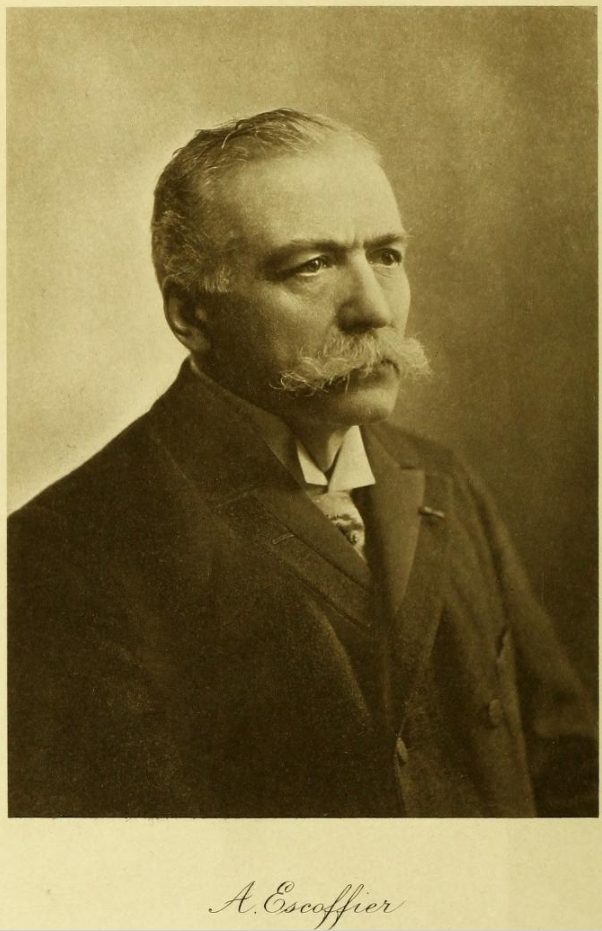
The book became one of the great landmarks of French gastronomy, used and studied by generations of chefs.
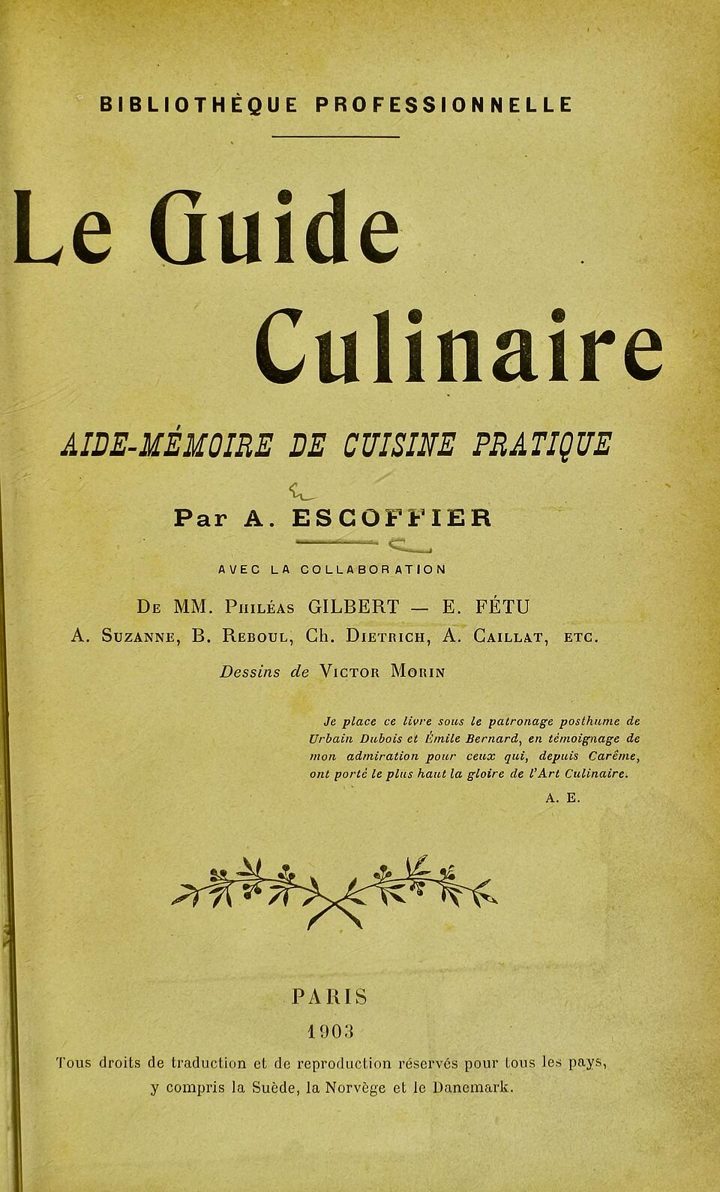
It is precisely this work I chose in order to return to a classic béchamel, with a precise source.
And I discovered a recipe different from the simple sauce I usually make at home.
Escoffier's 1903 béchamel contained veal.
The original recipe in Le Guide culinaire
On printed page 19, Escoffier gives the following quantities for five litres of sauce:
- 650 g white roux (roux blanc).
- 5 litres hot milk.
- 300 g lean veal, diced.
- 2 small onions, finely chopped.
- A sprig of thyme.
- A pinch of coarsely crushed pepper (mignonnette).
- A little grated nutmeg.
- 25 g salt.
- Butter for sweating the meat and finishing the sauce.
These are the quantities recorded in the original recipe.
In this passage the author does not specify the weight of the extra butter used for sweating and finishing.
What is white roux?
White roux, roux blanc in French, is a mixture of fat and flour, cooked briefly, without browning.
Escoffier describes how to make it separately, in the chapter devoted to roux.
For a large quantity of white roux, his formula starts from:
- 500 g butter.
- 600 g flour.
The mixture is cooked for only a few minutes, just long enough to remove the taste of raw flour.
Escoffier also pays attention to the quality of the fat, recommending clarified butter or purified fats for making roux.
There is a detail here worth explaining.
The 650 g of white roux in the béchamel recipe is the amount of prepared roux, not 650 g of flour.
And the general formula of 500 g butter and 600 g flour should not be confused with the amount intended for one litre of béchamel.
How was the sauce prepared?
The veal was diced and sweated in butter with the onion, without browning.
Separately, the white roux was mixed with the hot milk until a smooth sauce formed.
The meat, onion, thyme, pepper, nutmeg and salt were added.
The sauce was left to simmer gently for about an hour.
Finally, it was passed through a fine cloth, and the surface was brushed with a little butter to stop a skin forming.
Escoffier noted that the veal could be left out when the sauce was meant for meatless dishes, but the flavouring ingredients had to be kept.
Escoffier's quick version
In the same book, on printed pages 19–20, the author also describes a quicker method.
The boiled milk was flavoured with onion, thyme, pepper and nutmeg.
The pan was covered and kept warm for about ten minutes, so the ingredients could pass their flavours to the milk.
The infused milk was then poured over the white roux, and the sauce was brought to the boil and cooked for another 15–20 minutes.
This method is closer to what I would like to try in an ordinary kitchen.
And it keeps something I find essential: it is not limited to butter, flour and milk.
The onion, thyme, pepper and nutmeg help build the flavour.
How would I adapt the proportions for one litre?
Here I want to keep an important distinction between the original recipe and a calculation for the home kitchen.
Escoffier gives the proportions for five litres.
Dividing by five gives:
- 130 g white roux, already prepared.
- 1 litre milk.
- 60 g veal, if the version with meat is chosen.
- 5 g salt.
These four quantities come directly from scaling the recipe down proportionally.
For the onion, thyme, pepper and nutmeg, adapting to one litre also requires a practical choice, because some ingredients are given as pieces or approximate amounts.
For example, two small onions for five litres would mathematically correspond to a fraction of an onion for one litre.
It would not be right to present half an onion as the exact amount Escoffier gives for one litre.
Likewise, I cannot claim that a particular combination of grams of butter and flour is a literal transcription of his one-litre recipe, because that version does not appear separately in the 1903 text.
For my cookbook, I want to keep Escoffier's recipe with its original quantities, alongside a one-litre adaptation explicitly marked as such.
I would start with the quick version, without veal, which the author allows by leaving out the meat and keeping the flavouring ingredients.
For now it remains a recipe to try, not one I claim to have already made.
From Mirela's “To try” collection · after Auguste Escoffier, Le Guide culinaire (1903)
Béchamel sauce – Auguste Escoffier, Le Guide culinaire (1903)
1 litre of sauce
Ingredients
- 130 g white roux, already prepared
- 1 litre milk
- 5 g salt
- onion, a sprig of thyme, coarsely crushed pepper and a little grated nutmeg (amounts chosen practically; the original uses 2 small onions for 5 litres)
Method
- 1
Boil the milk and flavour it with the onion, thyme, pepper and nutmeg.
- 2
Cover the pan and keep it warm for about ten minutes, so the flavours pass into the milk.
- 3
Pour the infused milk over the white roux, stirring until the sauce is smooth.
- 4
Bring the sauce to the boil and cook for another 15–20 minutes.
Serving
The quick version, without veal, adapted for one litre from the original proportions. A recipe to try.
Escoffier's original recipe is written for 5 litres (650 g white roux, 5 litres milk, 300 g veal, 25 g salt). The one-litre quantities are a proportional calculation, not a formula written separately by Escoffier. Kept in Imortela · app.imortela.com
1934: Escoffier and a béchamel closer to today's
More than three decades later, in 1934, Escoffier published Ma Cuisine, a book of about 2,500 recipes intended to make the techniques of French cooking more accessible.
On printed page 16 I find a béchamel formula closer to the modern tradition.
For one litre of sauce, Escoffier starts from a blond roux and one litre of hot milk.
Blond roux is similar to white roux, but cooked a little longer, until it takes on a faint golden colour.
The ingredients described in Ma Cuisine
- Blond roux.
- 1 litre hot milk.
- 8 g salt.
- A little coarsely crushed pepper.
- A small amount of grated nutmeg.
- Half a medium onion, studded with a clove.
- A few parsley stalks.
- Half a bay leaf.
- A sprig of thyme.
How was it prepared?
The blond roux was thinned with the hot milk, whisking.
Once the sauce began to boil, the salt, pepper, nutmeg, the onion with its clove and a small bouquet of parsley stalks, bay and thyme were added.
The sauce was cooked over a low heat for about 25–30 minutes.
Escoffier recommended particular care to stop the sauce sticking to the bottom of the pan.
Finally, it was passed through a fine cloth and finished with a little butter.
The veal no longer appeared in this formula.
But the flavouring ingredients remained important.
But how much butter and flour were used?
In the passage on béchamel in Ma Cuisine, Escoffier does not explicitly give the weight of roux needed for one litre of sauce.
Instead, in the chapter on roux, he describes a blond roux formula starting from 50 g clarified butter and 60 g flour.
This is, however, a separate formula for making roux. It does not show that the whole amount should be used for the litre of béchamel.
That is why the two indications must be read together, without attributing to the author a weight for béchamel that he did not state explicitly.
And even in this simpler version, nutmeg, onion, thyme, bay and clove still played a part in the flavour of the sauce.
So which is the original recipe?
Having followed these books, I understood that the answer depends on what I mean by “original”.
If I mean an early record of the name being used, I arrive at the turbot à la Bechameille described by Vincent La Chapelle in 1733.
If I mean a sauce proper, presented on its own, François Marin's 1758 recipe is an important documentary landmark.
If I want to understand the elaborate versions of professional gastronomy, I can follow André Viard's 1806 recipe and the béchamel with veal described by Auguste Escoffier in 1903.
And if I want a sauce closer to the one I recognise today, I find in Ma Cuisine, from 1934, a formula without meat but with many flavouring ingredients.
On the basis of these documents, I cannot point to a single person who certainly invented béchamel sauce.
I can, however, follow how the recipe changed.
From herbs and cream, to long-reduced sauces, veal, milk and roux, béchamel evolved together with French cooking.
And among the ingredients that return in several of these versions, one caught my attention in particular:
Nutmeg.
A recipe can keep more than a flavour
When I began researching the history of béchamel, I thought I would find an inventor, a date and an original recipe.
Instead, I found different cooks, books published decades apart and versions of the same sauce that sometimes have little in common.
I found turbot, veal, cream, milk, shallots, parsley, thyme, cloves and nutmeg.
I found long-reduced sauces and techniques that demanded more patience than many modern recipes.
And I understood that a recipe is not always something fixed, invented on a single day by a single person.
Sometimes it is the result of small changes made by different cooks, in different kitchens, over generations.
Perhaps this is the beauty of old cookbooks: they show us not only what people cooked, but also how their tastes changed.
For me, béchamel also holds the memory of that French book found online long ago, from which I made the sauce with such curiosity.
The title of the book has since been lost.
But this time I have found a source I can identify precisely: Le Guide culinaire, by Auguste Escoffier, published in 1903.
I chose to keep his quick béchamel in the “To try” section of my digital cookbook, Imortela, together with its source and its story.
I don't yet know whether it will become my favourite béchamel.
But I do know that when I come back to it, I won't have to search for the book it comes from again.
Because some recipes are worth keeping not only for what we cook with them, but also for the stories and memories they gather.
Historical sources and bibliography
- François-Pierre de La Varenne — Le Cuisinier françois (1651). The attribution of béchamel to La Varenne is discussed in Hervé This's study.
- Vincent La Chapelle — The Modern Cook, volume III (1733), p. 138 – digitised edition, Wikimedia Commons
- François Marin — La Suite des Dons de Comus, 1758 edition, the sauce à la Béchamel recipe, quoted by Hervé This.
- André Viard — Le Cuisinier impérial (1806), reproduced and discussed by Hervé This.
- Marie-Antoine Carême — Le Cuisinier parisien, ou L'art de la cuisine française au dix-neuvième siècle (1828).
- Marie-Antoine Carême — L'Art de la cuisine française au XIXe siècle (1833).
- Auguste Escoffier — Le Guide culinaire (1903), the original béchamel recipe, p. 19
- Auguste Escoffier — Le Guide culinaire (1903), the quick method continued, p. 20
- Auguste Escoffier — Le Guide culinaire (1903), the white roux formula, p. 14
- Auguste Escoffier — Le Guide culinaire (1903), Court-bouillon D, p. 387
- Auguste Escoffier — Ma Cuisine (1934), blond roux and one-litre béchamel, p. 12 and p. 16 – Wikisource
- Hervé This — „Doit-on parler de sauce béchamel, de sauce Béchamel, de sauce béchamelle, de Béchamelle?”, April 2025, Académie d'Agriculture de France (PDF)
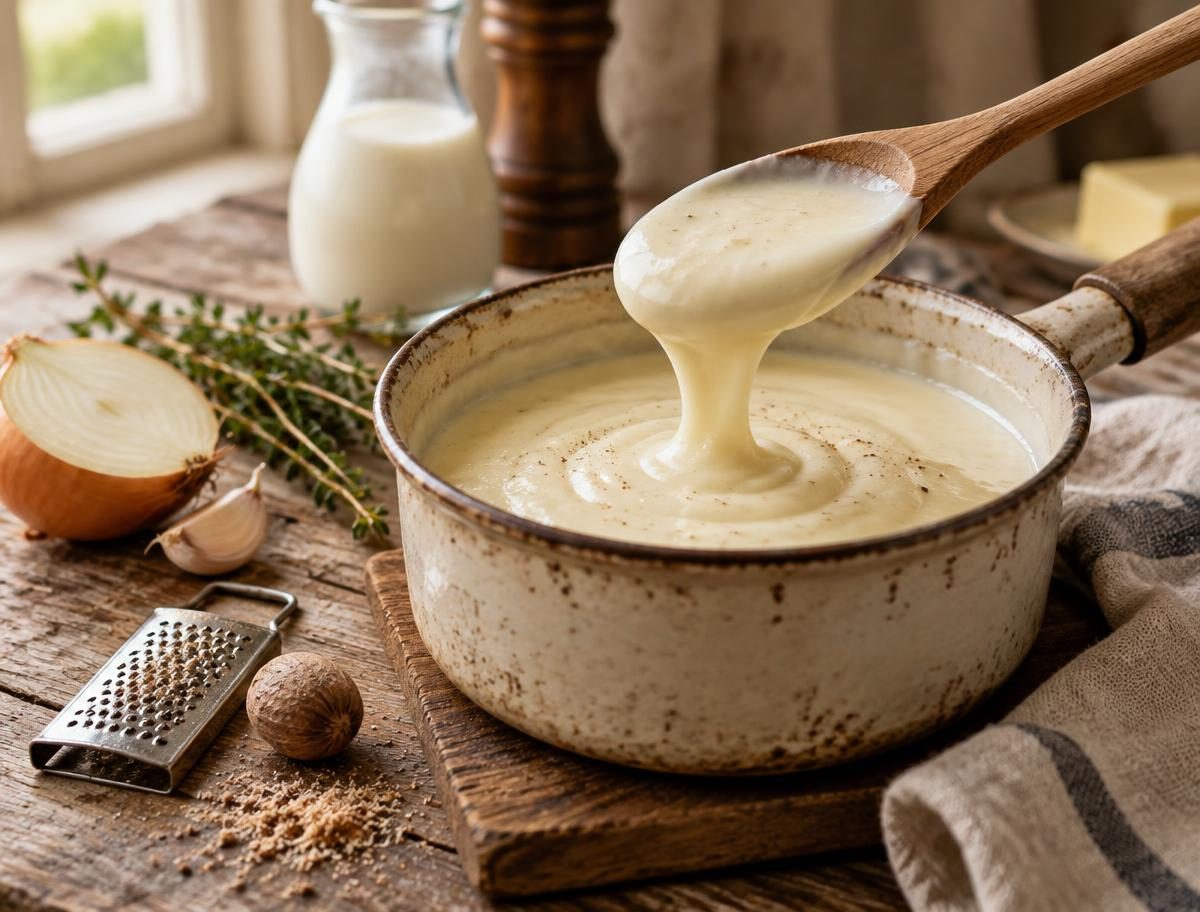
- The illustrative image of the béchamel sauce — generated with AI for this article.
- Portrait of Auguste Escoffier (around 1907) — Wikimedia Commons, file “Escoffier A Guide to Modern Cookery 1907 frontispiece.jpg”, public domain
- Title page of the first edition of Le Guide culinaire (Paris, 1903) — Wikimedia Commons, file “Escoffier Guide culinaire 1903 tp.jpg”, public domain
The historical recipes are presented by summarising and rewording the methods from the sources listed, not by translating the texts in full. Escoffier's recipes were checked against the digitised editions. For La Chapelle's 1733 dish, the digitised text and matching reproductions of the passage were used. Marin's and Viard's recipes are presented on the basis of the passages reproduced in Hervé This's research. Where the historical authors give no exact quantities, none have been added by guesswork. The proportional reduction of Escoffier's 1903 recipe to one litre is a calculation explained separately, not a one-litre recipe attributed to the author. The quick version from Le Guide culinaire is kept for a future attempt and is not presented as an already tested recipe. For Carême, only his historical role in codifying the base sauces is summarised, without claiming to reproduce a recipe card with exact quantities.
Warmly,
Mirela C